

IB LEARNER PROFILE
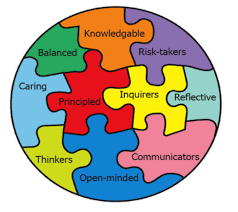
The IB Learner Profile are the qualities that we strive for all students to develop as they progress through the IB program. Teachers create lessons to highlight these profiles in historical figures, children's literature, and our students themselves. The school recognizes the qualities in students when demonstrated.
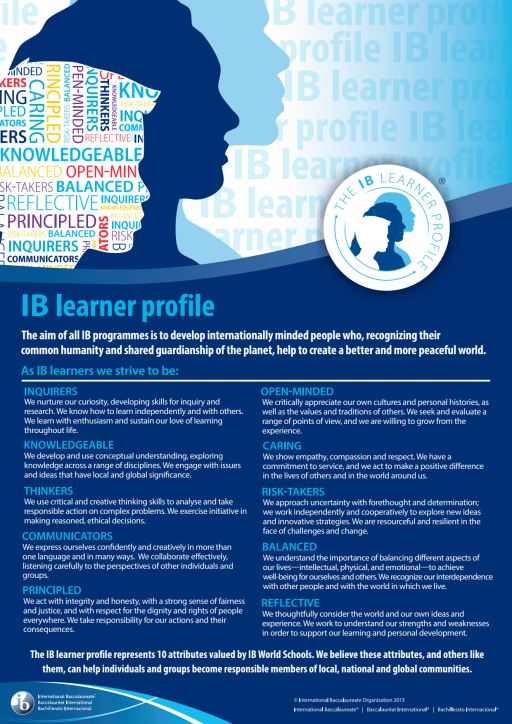
Together, families and school staff can support the whole child in developing these learner profiles through:
-
Inquirers: Parents can nurture curiosity by encouraging children to ask questions and explore topics of interest. Providing resources like books and educational games can help children develop a love for learning and research. Teachers can share classroom inquiry projects with parents, who can then extend these explorations at home. Regular communication between parents and teachers about students' interests can help tailor learning experiences.
-
Knowledgeable: To support this profile, parents can engage children in discussions about various subjects, share interesting facts, and encourage reading diverse materials. Teachers can provide parents with reading lists and resources that complement classroom learning. By attending school events and participating in educational activities, parents and teachers can collaboratively expand children's knowledge base.
-
Thinkers: Parents can foster critical thinking by presenting real-life problems for children to solve and encouraging them to consider different perspectives. Teachers can design classroom activities that challenge students' thinking and share these strategies with parents. Jointly, they can create a consistent environment that promotes analytical and problem-solving skills.
-
Communicators: Encouraging children to express their thoughts and feelings clearly and listening actively can support this profile. Parents can also promote learning new languages and effective communication techniques. Teachers can provide opportunities for students to present their ideas in class and share communication strategies with parents. Regular parent-teacher meetings can ensure both parties are aligned in supporting children's communication development. We value clear and consistent communication within and between all stakeholders.
- Principled: Parents can model ethical behavior and discuss the importance of honesty, fairness, and respect. Setting clear expectations and discussing the consequences of actions helps children understand and practice integrity. Teachers can reinforce these values in the classroom and communicate with parents about behavior expectations. Together, they can create a consistent message about the importance of principles
-
Open-minded: To support open-mindedness, parents can expose children to different cultures, ideas, and viewpoints. Encouraging respectful discussions about differences helps children appreciate diversity and become more accepting. Teachers can incorporate multicultural education in their curriculum and share these experiences with parents. Collaborative projects that involve both home and school can broaden children's perspectives.
-
Caring: Parents can foster empathy by involving children in community service and encouraging acts of kindness. Discussing the impact of their actions on others helps children develop compassion and a sense of responsibility. Teachers can organize classroom activities that promote caring behaviors and share these initiatives with parents. Joint efforts in community service projects can strengthen the caring attitude in children.
-
Risk-takers: Encouraging children to step out of their comfort zones and try new activities supports this profile. Parents can praise efforts and resilience, helping children build confidence and courage. Teachers can create a safe classroom environment where students feel comfortable taking risks and share these practices with parents. Both can celebrate children's efforts and progress, reinforcing the value of being a risk-taker.
-
Balanced: Parents can promote a balanced lifestyle by encouraging physical activity, healthy eating, and time management. Supporting hobbies and relaxation helps children understand the importance of mental and physical well-being. Teachers can integrate physical activities and mindfulness practices into the school day and communicate these efforts to parents. Together, they can ensure children maintain a balanced routine.
-
Reflective: Parents can help children develop self-awareness by encouraging them to think about their experiences and learn from them. Discussing successes and areas for improvement fosters a growth mindset and continuous learning. Teachers can incorporate reflective practices in the classroom and share these methods with parents. Regular reflections on learning experiences at home and school can help children develop a deeper understanding of themselves.
By fostering a collaborative environment where parents and teachers work together, we can support students in becoming compassionate lifelong learners. Encouraging curiosity, critical thinking, and open-mindedness helps children develop a love for learning and an appreciation for diverse perspectives. Modeling ethical behavior and promoting empathy through community service and caring actions instills a sense of responsibility and compassion. By celebrating efforts, resilience, and balanced lifestyles, we help children build confidence and well-being. Reflective practices at home and school ensure continuous growth and self-awareness. Together, we create a nurturing and consistent environment that empowers students to thrive academically, socially, and emotionally, preparing them to contribute positively to the world.
Approaches to Learning Skills
The IB PYP emphasizes Approaches to Learning (ATL) skills to help students develop essential abilities for lifelong learning. These skills include thinking skills, communication skills, social skills, self-management skills, and research skills.
- Thinking skills involve critical and creative thinking, enabling students to analyze information, solve problems, and generate new ideas. For example, students might brainstorm solutions to a community issue.
- Communication skills focus on effective interaction through listening, speaking, reading, and writing. Students might present a project or write a reflective journal.
- Social skills help students collaborate and work effectively in groups, fostering teamwork and empathy. Participating in group activities or peer feedback sessions are examples.
- Self-management skills include organization, time management, and emotional regulation, helping students stay focused and balanced. Setting personal goals or managing a study schedule are practical applications.
- Research skills involve gathering, analyzing, and presenting information, encouraging curiosity and inquiry. Conducting experiments or researching a topic for a presentation are typical examples.
By developing these ATL skills, students become more independent, confident, and capable learners, ready to tackle challenges both inside and outside the classroom.
The approaches to learning skills and learner profile attributes directly align with PWCS Profile of a Graduate.
Resources:
https://www.ibo.org/benefits/learner-profile/
https://www.ibo.org/programmes/primary-years-programme/curriculum/learning-and-teaching/
www.pwcs.edu/about_us/strategic_plan/p_w_c_s_profile_of_a_graduate